Collectibles

The Flex Pile

A trading card binder app. Organize the collection, track what it's worth, show off the pile.

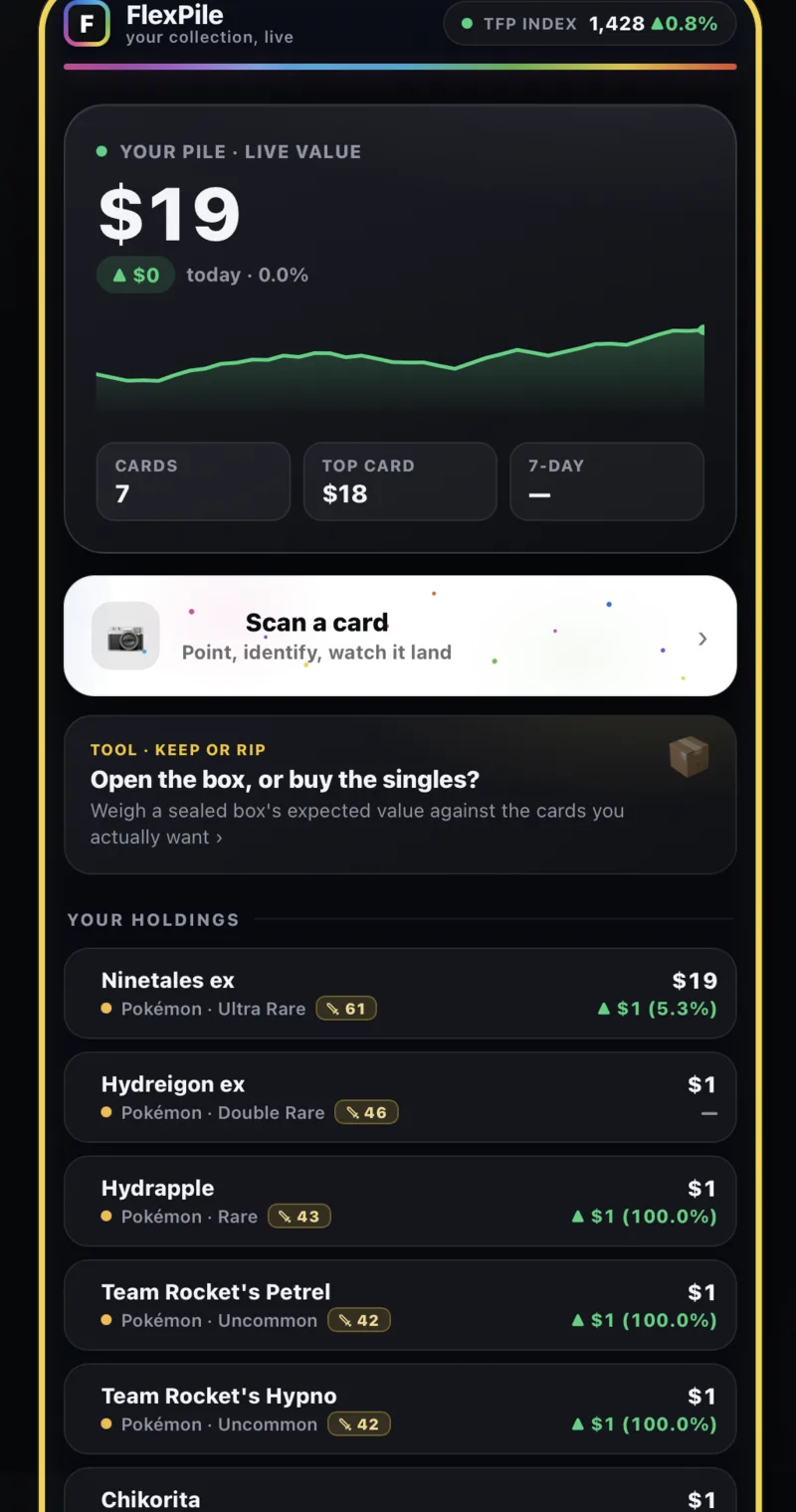
The Flex Pile mobile view showing live collection value, a value-over-time chart, card scanning, and individual card holdings with prices
The pile, live: total value, the chart, and every card priced. Scan a card and watch it land.

Not everything needs a business case.

The Flex Pile is a binder app for trading card collectors. It exists because collecting is fun, showing off the pile is half the point, and I wanted to build something outside the music industry to prove the stack generalizes. It's the least serious product in the lineup and I'm at peace with that.

It also turned out to be the most technically interesting one — because "point your camera at a card and know what it is and what it's worth" is a much harder problem than it sounds.

Scan it, stack it, flex it

What it's built on

React Tailwind Supabase Node.js Vercel Gemini (vision)

Where it fought back

A fun app, two genuinely hard problems.

Vision models are confidently wrong

Trading card games are an adversarial dataset by accident: thousands of near-identical cards, reprints across sets, alternate arts sharing the same artwork. Gemini would identify a card, sound completely certain, and be wrong in ways a collector spots instantly — which is the one audience you can't fool.

The lesson wasn't "write a better prompt." It was architectural: treat the model's answer as a guess to be verified, not a fact to be stored. Once the app stopped blindly trusting its smartest component, accuracy stopped being a crisis and became a workflow.

Pricing data is a moving target

"What's it worth?" sounds like one number. It isn't — the same card maps to multiple listings depending on printing and edition, and a price that was right last week is wrong today. Matching a physical card in someone's binder to the right market listing, and keeping that number honest over time, took real work. A stale price is worse than no price: it teaches users to distrust the app.

Building something on top of an AI model?

The gap between "the model answers" and "the app is right" is where these products live or die. I've built on vision models and language models both — happy to talk through yours.

Get in touch